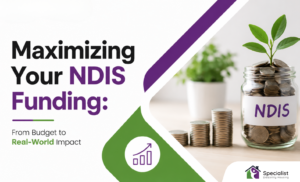


Many NDIS conversations focus on getting more funding. But there’s an equally important arguably more important conversation that receives far less attention: making the funding you have deliver maximum benefit.
The reality is this: your NDIS allocation isn’t primarily about the dollar amount. It’s about whether that funding translates into genuine progress toward your goals, meaningful community participation, improved wellbeing, and real quality-of-life improvements. Maximizing your funding means transforming budget lines into life outcomes.
The Foundation: Strategic Provider Selection
Your choice of service providers—particularly your support coordinator—fundamentally shapes funding efficiency. Many participants choose providers based primarily on cost, assuming cheaper is smarter. This logic frequently backfires.
A low-cost provider who can’t effectively support you toward your goals wastes every dollar spent. Conversely, a quality provider who truly understands your needs, communicates clearly, and delivers consistent outcomes may cost more hourly but delivers exponentially better value.
Before selecting providers, research thoroughly. Ask for recommendations from other participants, your LAC, or disability advocacy organizations. Look for providers who demonstrate:
- Track record of participant success (not just service delivery)
- Values alignment with your priorities and communication style
- Flexibility and responsiveness to evolving needs
- Genuine commitment to your goals, not just billing hours
Quality provider relationships compound over time. Familiarity breeds efficiency. Better outcomes create momentum.
The Hidden Money Drain: Provider Travel Costs
One of the most overlooked funding drains is provider travel time and expenses. When your therapist spends 30 minutes driving to your home, all that travel time gets billed against your funding at professional rates. Over 12 months of regular appointments, travel costs can consume hundreds—sometimes thousands—of dollars.
Strategic use of telehealth reshapes this equation entirely. Video conferencing eliminates travel time billing while maintaining therapeutic quality for many support types. A combination approach works best: critical face-to-face sessions when in-person connection matters deeply, and telehealth for routine appointments.
The savings accumulate significantly. Monthly therapy sessions conducted via video instead of in-person can redirect thousands of dollars annually toward other priorities or extend support hours.
Intentional Planning: Goals First, Funding Second
Many participants receive their NDIS plan and immediately start “spending” funding on available supports. This backwards approach scatters resources across priorities rather than concentrating them strategically.
Instead, the opposite approach transforms outcomes: Start with your goals, then allocate funding to achieve them. What matters most to you? Better employment prospects? Stronger social connections? Health improvements? Community participation? Greater independence in specific areas?
Once goals crystallize, break them into achievable steps. What specific supports would meaningfully advance each goal? How can funding be allocated across 12 months to sustain progress without running out too early?
This intentional planning prevents funding from being “whittled away on low priority tasks” and ensures money flows toward what genuinely matters to you and your family.
Smart Support Choices: Flexibility Within Your Budget
NDIS funding categories are structured, but that doesn’t mean you’re locked into specific service types. Psychology and counselling serve similar purposes at different price points. Exercise physiology and physiotherapy overlap considerably in outcomes yet carry different costs. A Clinical Nurse Consultant can establish health protocols that support workers implement at lower rates, delivering the same results more cost-efficiently.
Exploring alternative support options that deliver equivalent outcomes for lower costs is smart financial strategy. However, this exploration requires balance the cheapest option isn’t always the best if it compromises quality or introduces risk.
Leveraging Informal and Community Supports
Your NDIS funding exists within a broader ecosystem that includes family support, community resources, and mainstream government services. While family capacity shouldn’t be exploited, informal support networks naturally contribute to participant goals. Strategic use of these networks—combined with your NDIS funding for specialized supports—creates comprehensive, efficient support architecture.
Additionally, all Australian government services have legislative obligations to make reasonable adjustments for people with disabilities. You can access these services even while receiving NDIS funding. Community programs, grants, recreation opportunities, and mainstream supports often cost significantly less than disability-specific services while delivering excellent outcomes.
The Self-Management Advantage
Self-managing your NDIS funding isn’t for everyone, but it’s worth understanding. When you self-manage, you hire directly, negotiate rates, and eliminate intermediary administrative costs. This creates genuine purchasing power—more flexibility, better rates, and direct provider relationships.
The trade-off? Increased administrative responsibility and compliance obligations. Some participants find this empowering; others find it overwhelming. Assess your capacity honestly before deciding.
Continuous Monitoring and Adjustment
Finally, maximizing funding requires ongoing attention. Monthly check-ins with your support coordinator should review: Are funds being spent as planned? Are spending patterns supporting your goals? Do adjustments make sense? Should priorities shift?
Active fund management prevents nasty surprises at reassessment while ensuring your allocation genuinely serves your evolving needs.
Action Steps to Maximize Your Funding:
- Schedule monthly fund reviews with your support coordinator
- Research quality provider options aligned with your goals
- Create written goals and break them into achievable steps
- Explore telehealth options for appropriate supports
- Research alternative support options that deliver equivalent outcomes at lower cost
- Assess whether mainstream government services can complement your NDIS funding
- Consider whether self-management aligns with your organizational capacity
 Let’s Stay Connected
Looking for assisted living or disability housing support?
 info@sdhwa.com.au
(08) 9468 5550

FAQ’s
1. Should I choose the cheapest provider to save NDIS funding?
Not necessarily. Cheapest hourly rates don’t equal best value if providers can’t support your goals effectively. Quality providers delivering results provide better value. Research track records and testimonials before choosing based on price alone.
2. How much can I save using telehealth instead of face-to-face therapy?
Eliminating 30 minutes travel time per session saves roughly $97 per appointment (typical therapy rates). Weekly sessions via telehealth save approximately $5,000 annually. Hybrid models combining necessary in-person sessions with telehealth optimize cost and relationship.
3. What’s the difference between choosing Counselling versus Psychology for my support needs?
Both provide mental health support at different rates—Counselling (~$156/hr) vs Psychology (~$235/hr). If your goals suit counselling, the cost savings over 12 months are substantial. Discuss with your coordinator which matches your needs best.
4. How often should I review my funding spend with my support coordinator?
Monthly reviews are ideal. Track spending alignment with your plan, identify issues early, and prevent mid-plan surprises. Many coordinators use tracking software showing exactly what’s spent and remaining. Request monthly reviews if not offered.
5. Is self-managing my NDIS funding worth the extra paperwork?
Self-management works for organized participants wanting flexibility and better rates. You hire directly, negotiate rates, and eliminate intermediary costs. Trade-off: increased paperwork and compliance obligations. Assess your capacity honestly. Apps like Real Support Choices can help.